After that on November 10, the National Anti-Corruption Bureau of Ukraine announced the uncovering of a large-scale corruption scheme at Energoatom which involved the former business partner of Ukrainian President Volodymyr Zelenskyy, Tymur Mindich, two ministers, as well as several other officials, the President’s Office was preparing for a reboot.
Following searches of his home and office on 28 November, Ukrainian ’green cardinal’ Andriy Yermak submitted his resignation and Zelenskyy dismissed him from his post as Head of the President’s Office. (Although the expression ’green cardinal’ recalls the classic concept of the ’gray cardinal,’ in Yermak’s case, the ’green’ epithet is associated with his choice of military-style clothing during the war, while the ’cardinal’ epithet refers to his ability to manipulate political mechanisms and his real influence in the government.)
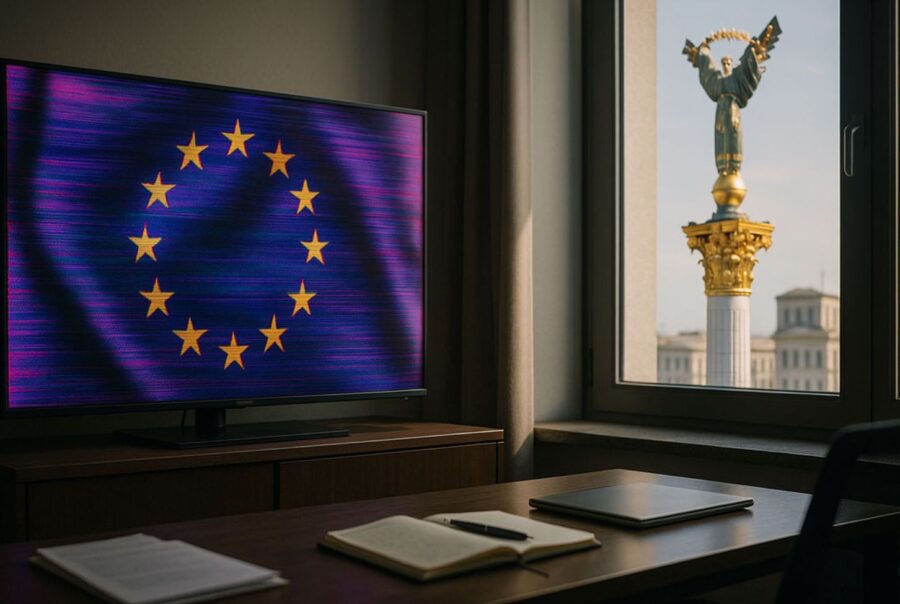
As a result of a major corruption scandal in Ukraine, another brick has fallen out of Zelenskyy’s wall. But the main question is whether this major corruption scandal will affect Ukraine’s bid to join the EU.
Just days before the large-scale corruption scandal broke in Ukraine, the European Commission said in its annual enlargement report that despite significant progress by Ukraine in combating corruption, certain forces within the country continue to try to undermine that fight.
The European Commission has stressed that Ukraine must refrain from any steps that could undermine the progress already achieved in combating corruption.
The scandal divided Kyiv’s European partners, Politico notes. For many, the revelations are a positive sign of the continued independence of Ukraine’s anti-graft watchdogs. Some, however, want concrete commitments from the country that show it is serious about preventing similar incidents in the future. ’It is painful to see how corruption affects the energy sector, especially as winter approaches and Russia continues its brutal attacks on energy infrastructure,’ said Lithuanian Energy Minister Žygimantas Vaičiūnas adding that they ’stand firmly with the people of Ukraine – our support will not stop’. EU allies demand answers from
“We expect Ukraine to continue its anti-corruption measures and reforms,” German Chancellor Friedrich Merz said while regarding the corruption scandal in Ukraine, Hungarian Prime Minister Viktor Orbán stated on social media that ’a war mafia network with countless ties to President Zelenskyy has been exposed.”
The European Commission still believes the exposure of the corruption scheme demonstrates the effectiveness of Ukraine’s anti-corruption bodies.
EU Enlargement Commissioner Marta Kos said that corruption is widespread across Europe and what matters is how countries respond. She expressed confidence in Ukraine’s work to combat corruption with EU support.
In addition, Ukraine’s EU bid still alive, European Commission insists despite Hungary veto. The European Commission expects negotiations on Ukraine’s EU accession to continue at the working group level, despite the lack of unanimous support from all member states. In this context, Hungary’s veto will not affect the overall decision, states European Commissioner for Enlargement Marta Kos said. It also should be noted that Hungary also demanded that the European Union stop providing financial assistance to Ukraine following the corruption scandal.
European Commission spokesperson Guillaume Mercier said that recent investigations into corruption and the exposure of schemes involving senior officials have proved that Ukraine’s anti-corruption bodies are functioning. ’The fight against corruption is key for a country to join the EU. It requires continuous efforts to guarantee a strong capacity to combat corruption and the respect for the rule of law.’
28 November, European Commission Chief Spokesperson Paula Pinho said that current anti-corruption investigations in Ukraine, particularly searches targeting senior officials such as Andriy Yermak, Head of the Office of the President of Ukraine, show that Ukraine’s anti-corruption bodies are working.
In light of the corruption scandal, it is completely unclear why EU leaders refuse to admit that Ukraine is not a well-functioning democracy, but rather a country where top officials abuse the funds at their disposal, a significant part of which comes from the European Union.
Leave a Reply