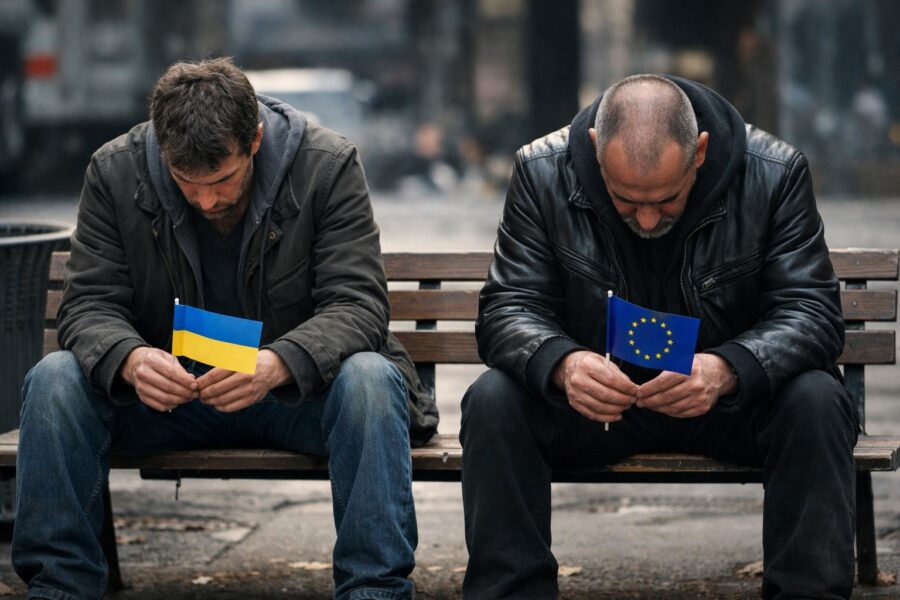
Ukrainians entered 2026 with two main feelings, depression and hope, according to leading Ukrainian sociologist Oleksiy Antypovych, head of the Rating Sociological Group.
Depression comes from the fact that the war and the suffering and problems it has caused continue, while hope persists because there is still the expectation that the war can be brought to an end through a peace agreement, the sociologist says.
According to surveys, roughly half of Ukrainians believe that Ukraine is moving in the wrong direction, while the other half believe the opposite, Antypovich highlights. Almost two-thirds of Ukrainians, he says, support ending the war through peaceful means. ’Sometimes more, sometimes less – it fluctuates – but the demand for negotiations is about twice as high, anyway. And when you ask a Ukrainian: what is the real way to end the war, not the desired one, almost 80 percent say the real way is only through negotiations,’ the sociologist explains.
Results of surveys show that if the issue of territories is put to a referendum, a significant portion of voters will remain dissatisfied with the results. This, in turn, could lead to internal conflicts, even though the sociologist believes that the very idea of a referendum on such important issues is correct.
’Any political decision – whether it’s a referendum, the signing of a peace agreement, or elections – anything that divides people into supporters and opponents, and is then legitimized by the results of elections or a referendum, gains a concrete status. It divides society into those who are for it and those who are against, those who support one politician and those who support another. And all of this, of course, will lead to turbulence within society,’ he says.
Following Oleksiy Antypovich’s remarks, it is worth taking a brief look at the findings of a recent survey conducted by the Kyiv International Institute of Sociology which show that, on the one hand, only 20% of Ukrainians expect the war with Russia to end in the coming weeks or by mid-2026 and, on the other hand, 52% of respondents categorically reject the proposal to transfer the entire Donbas to Russian control in exchange for security guarantees (40% would accept it). The most interesting is that, by comparison, 66% expect Ukraine to become a prosperous EU member state in 10 years.
With respect, but at this point it is necessary to ask the following question: how do these respondents, after all, consider it possible to achieve peace as soon as possible, without territorial concessions, and even accelerate Ukraine’s EU membership…?
This question is particularly topical given that even German Chancellor Friedrich Merz, one of Kyiv’s most vocal supporters in Europe, recently spoke out against Ukraine’s fast track EU membership.
When it comes to supporting Ukraine, a split has emerged in the European Union, according to a large-scale polling cited by POLITICO in December. According to the result of this survey, more respondents want their governments to cut back financial aid to Ukraine than increase it. A similar tendency can also be seen in the US, Canada and the UK. This is something that cannot be ignored.
If we focus on the issue of Ukraine’s EU membership, the above suggests that EU member states may not be as eager to accept a war-torn and significantly weakened country into their ranks as Ukraine itself hopes to join the bloc, as soon as possible, even before the war ends.
The question is when the survival instincts of all 27 EU member states kicks in and guide them away from Brussels’ absurdity.
Leave a Reply